Tips and reminders for driving on racetrack
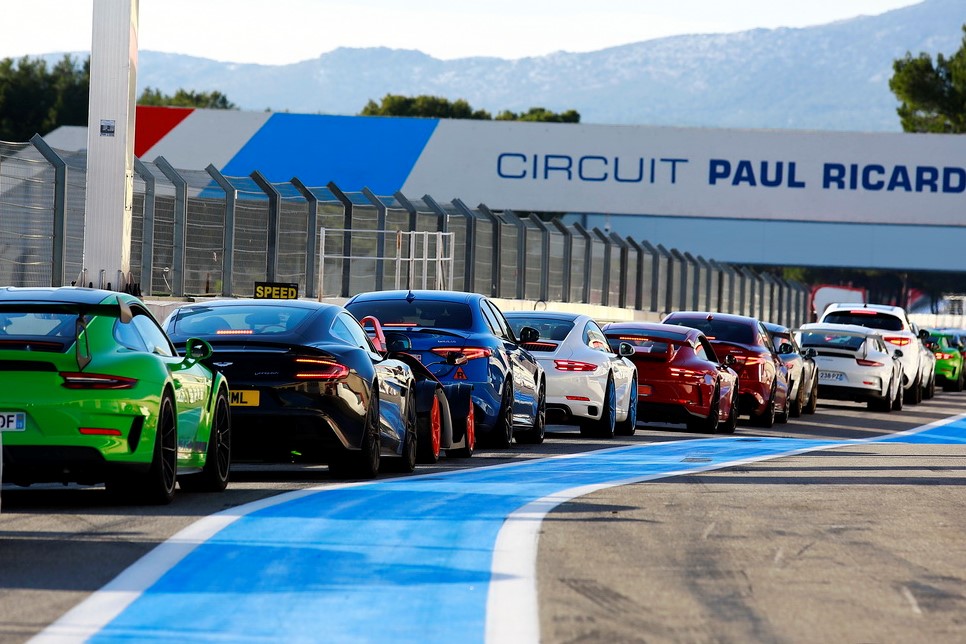
To have fun, to use and enjoy all the power and dynamics of the car, to improve and refine my driving skills : aren’t these the goals of a trackday ? Although there are no speed limits on a track, this does not mean that you should not follow some rules. An experienced driver should never provoke or push a less experimented driver (risk of accident). An inexperienced driver should never try to follow an experienced one. If he does, the crash is preprogrammed. To ‘slam the door’ or to try to ‘squeeze through’ when entering a turn : these are also behaviours that should be avoided in any case.
BRIEFING
All participants in a trackday must attend a safety briefing organized by the circuit and the organizer of the day. This mandatory briefing can be done in different ways : via the internet, on site at the beginning of the day, or both. If you don’t feel comfortable after the briefing (first time on a circuit, first time on the circuit of the day, etc…), hire an instructor or ask an experienced driver for help, for example by riding as a passenger in his car. Some organizers require beginners to hire an instructor for their first laps or organize an initial session of a few guided laps behind an instructor. This allows the beginners to learn the ideal trajectory and gradually gain confidence.


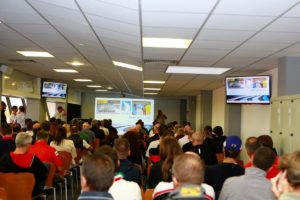
As an example, here is the link to the mandatory video briefing for driving at Circuit Bugatti / Le Mans (9’18) :
https://youtu.be/V4UvzHR42KI?si=Vd5ySKOLpWk_69Qm
FINAL PREPARATION AND CHECK BEFORE ENTERING THE TRACK
Before going on the pitlane and wanting to enter the track, make sure that car, driver and passenger are ready : stickers and tow hook/s fixed, car interior ’emptied’, sufficient gasoline, tire pressure OK, suitable clothes and helmets, driver/passenger wristbands, seatbelts fastened, windows closed.
ENTERING THE TRACK
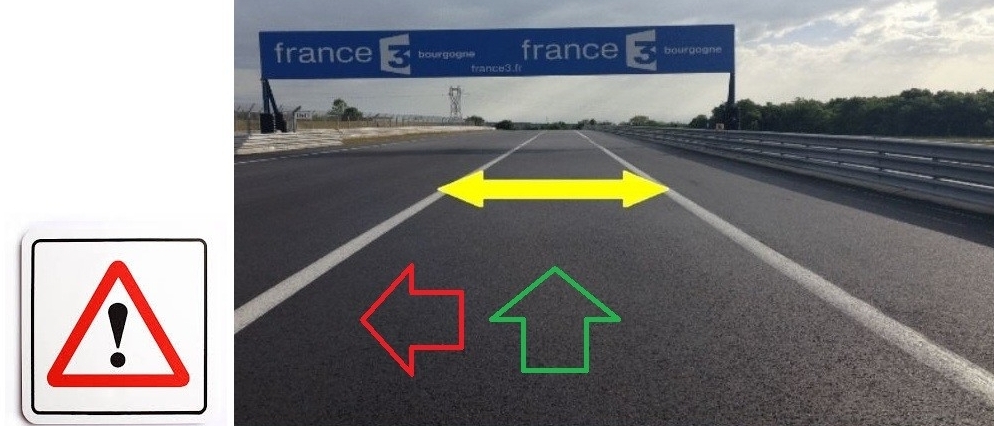
As soon as you enter the track, it is absolutely prohibitied on crossing the white line marked on the track after the pitlane exit ! While you are driving between the two white lines, you accelerate frankly and drive carefully onto the track after the separation lines, making sure via your mirrors that nobody is approaching at high speed. At Dijon-Prenois for example (picture here below), the best-performing GTs reach 250-300 km/h at the end of the straight, precisely where you enter the track…
FIRST LAPS
Give yourself, the engine, the tires and the brakes enough time to warm up and gradually increase the rhythm, lap by lap (otherwise there is an increased risk of spinning).
DRIVING
Look ahead, look far ahead (anticipation), search the ‘track horizon’ with your eyes but also look in your correctly adjusted rearview mirrors (making sure they are properly adjusted beforehand). A fundamental point that may seem trivial to some drivers: on the track, it is strictly forbidden to drive in the opposite direction (so, if you spin out, take the time to get your bearings and start driving again in the right direction). Drive with the windows closed; some circuits allow them to be opened 2-3 cm. Some drivers drive with the air conditioning on. Don’t drive while holding your breath : don’t forget to breathe and you can do small breathing exercises. Don’t overestimate your abilities : sometimes going off the track has no consequences; other times, however, it can be very expensive in terms of car repair costs and repair costs for damage caused to the track (rails, various protective barriers, etc.); moreover, no driver will be allowed on the track without first signing a liability waiver (for the track and the organizer).
OVERTAKING
• First point : on a racetrack, and unless the organizer of the day informs you otherwise, overtaking is allowed on the left and right side (exception : Nürburgring/Nordschleife/Touristenfahrten).
• Second point : the general rule is as follows : the driver who is about to be overtaken stays on the ideal line; the driver who is overtaking is responsible for his decision to overtake (in his judgment, he must ask himself : has the driver in front of me really seen me coming ? If you are not sure, wait. To make yourself visible, you can flash your headlights briefly. However, wisdom, caution, and experience teach us this : rather than trying to pass a slower rider at all costs by “cutting him off,” why not wait for the next straight and then pass safely (here we are talking about trackdays and not competition).
• Third point (more applicable to experienced drivers) : the driver who is about to be overtaken may decide to allow a faster driver to pass by moving out of the ideal line : in this case either he decides to move to the left of the track and immediately indicates this by using his left turn signal (and remains on the left of the track), or he decides to move to the right of the track and immediately indicates this by using his right turn signal (and stays on the right of the track).
BACK TO THE PIT
At the end of the stint, before returning to the pit, we recommand to make a slow down lap in order to cool down brakes, tyres and engine. The ‘slow down lap’ should be done at a fast pace to avoid a big difference in speed between me and the fast drivers. In order to cool down the car on an efficient way, you should maintain a certain speed anyway. To return to the pit, never cross the track diagonally : it is important to close the track side exit early. If there is to heavy traffic or you find out too late that you are on the ‘wrong’ side, then make another cooldown lap !
FAIRPLAY AND RESPECT
Never forget that we are all together here to have fun, among enthusiasts (respect, respect, respect) !